Pawan Prakash

Pawan Prakash

PhD Candidate in Physics · University of Florida · Gainesville, FL

I am a final-year PhD candidate at the University of Florida, advised by Richard G. Hennig and Peter J. Hirschfeld. I work on generative AI for materials discovery. I build diffusion, flow-matching and stochastic-interpolant models that propose new crystal structures, and I use reinforcement learning to steer them toward materials that are stable and have a target property. Machine-learned potentials and DFT then check the candidates before the most promising ones go to experimental collaborators for synthesis.

Much of my work so far is on superconductors. In summer 2026 I was a research intern at the Center for Nanophase Materials Sciences at Oak Ridge National Laboratory, where I worked on inverse design of 2D defect structures from a target density of states and on restoring beam-damaged electron microscopy images.

I expect to defend my thesis in December 2026 and am looking for research positions starting in 2027.

  • Generative models for crystals
  • Reinforcement learning
  • Equivariant GNNs
  • ML interatomic potentials
  • Superconductors

Publications

First author

Guided diffusion for the discovery of new superconductors

P. Prakash, J. B. Gibson, Z. Li, G. Di Gianluca, J. Esquivel, E. Fuemmeler, B. Geisler, J. S. Kim, A. Roitberg, E. B. Tadmor, M. Liu, S. Martiniani, G. R. Stewart, J. J. Hamlin, P. J. Hirschfeld, R. G. Hennig

npj Computational Materials 12, 286 (2026)Spotlight, NeurIPS 2025 AI4Mat

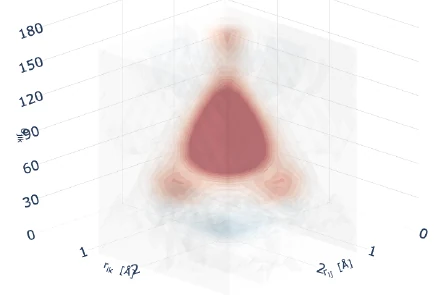
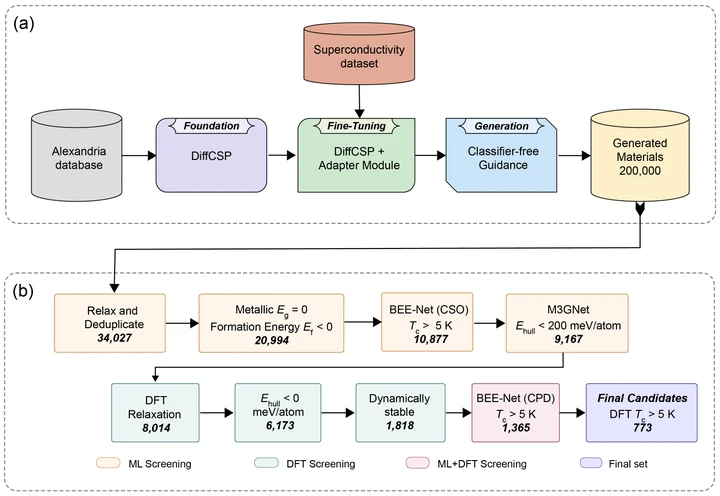
We fine-tune a crystal-structure foundation model with an adapter and classifier-free guidance so that it generates structures with a target superconducting Tc. Of 200,000 generated structures, 773 passed ML and DFT screening with Tc above 5 K.
Reinforcement learning on the discrete composition channel of a crystal generator: validated gains and reward hacking

P. Prakash, P. Höllmer, A. Fuhr, P. J. Hirschfeld, P. Ganesh, S. Martiniani, R. G. Hennig

arXiv:2610.03880 (2026), under review. Presented at the MRS Spring Meeting 2026.

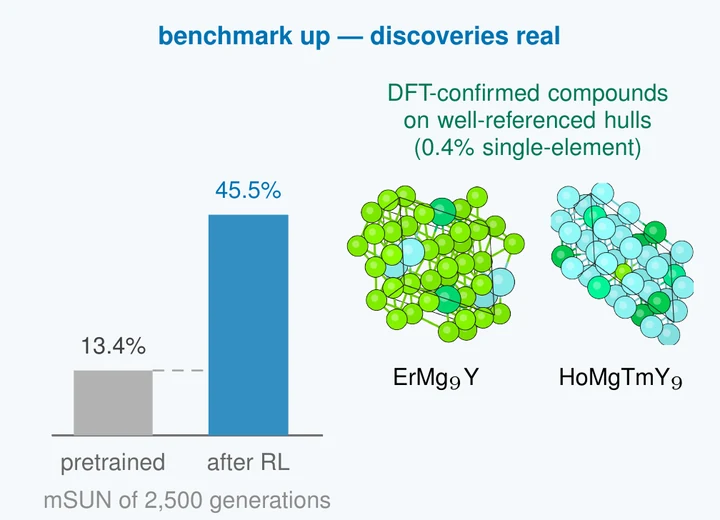
We fine-tune the OMatG generator with group-relative policy optimization, with the policy gradient acting directly on its discrete atom-type transitions. Our reward raises the yield of metastable, unique and novel structures from 13.4% to 45.5% on a community benchmark. We also show that reinforcing atom types invites reward exploitation unless the reward has explicit guards, and that single-element structures inflate the benchmark metric without giving any new compounds.

Co-author

Developing a complete AI-accelerated workflow for superconductor discovery

J. B. Gibson, A. C. Hire, P. Prakash, P. M. Dee, B. Geisler, J. S. Kim, Z. Li, J. J. Hamlin, G. R. Stewart, P. J. Hirschfeld, R. G. Hennig

npj Computational Materials 12, 95 (2026)

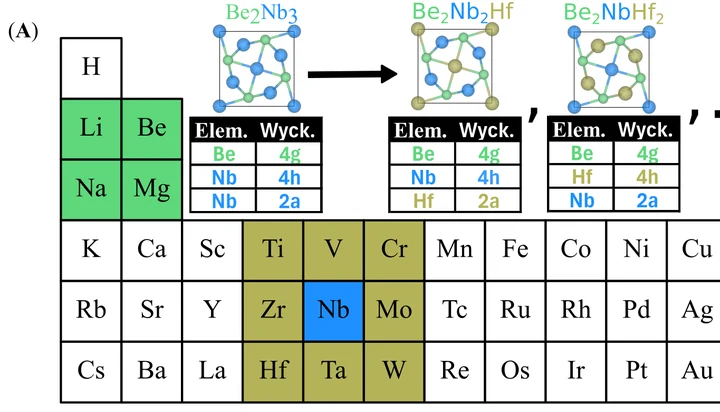
An ensemble of equivariant GNNs (BEE-NET) predicts the Eliashberg spectral function and Tc, and drives a screening pipeline that ends in DFT. Two of the predicted compounds were synthesized and confirmed to superconduct.

MolGuidance: advanced guidance strategies for conditional molecular generation with flow matching

J. Jin*, C. Zeng*, P. Prakash, E. B. Tadmor, A. Roitberg, R. G. Hennig, S. Martiniani, M. Liu

Journal of Chemical Information and Modeling 66(15), 8860–8874 (2026). Earlier version at the ICML 2025 GenBio workshop.

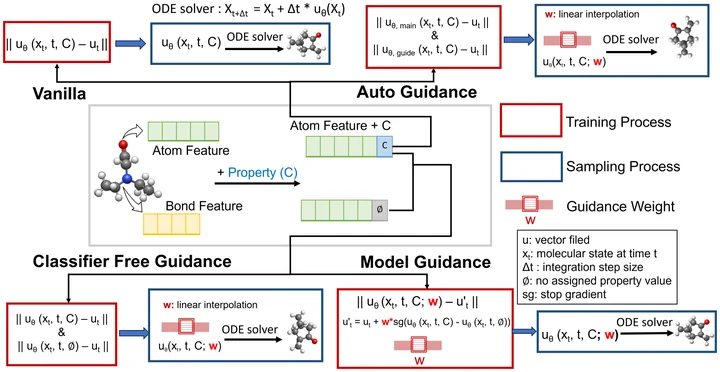
A comparison of guidance methods, including classifier-free guidance, autoguidance and model guidance, for property-conditioned molecule generation with flow matching.

Open materials generation with stochastic interpolants

P. Höllmer*, T. Egg*, M. M. Martirossyan*, E. Fuemmeler*, Z. Shui, A. Gupta, P. Prakash, A. Roitberg, M. Liu, G. Karypis, M. Transtrum, R. G. Hennig, E. B. Tadmor, S. Martiniani

International Conference on Machine Learning (ICML), PMLR 267 (2025)

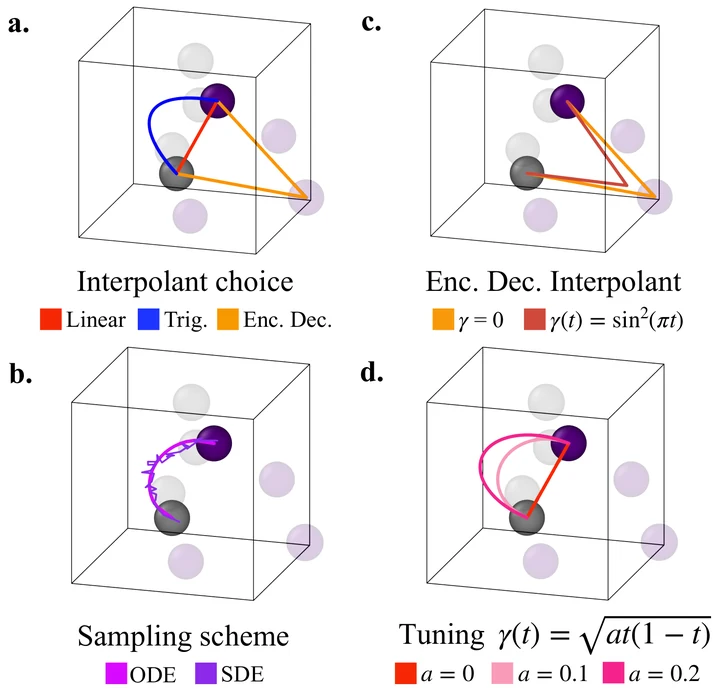
OMatG is a stochastic-interpolant framework for crystal structure prediction and de novo generation, with discrete flow matching for atomic species.

Discovery of spin-crossover materials with equivariant graph neural networks and relevance-based classification

A. Albavera-Mata, P. Prakash, J. B. Gibson, E. Fonseca, S. Ren, X.-G. Zhang, H.-P. Cheng, M. Shatruk, S. B. Trickey, R. G. Hennig

Journal of Chemical Theory and Computation 21(8), 3913–3921 (2025)

An equivariant graph network trained on DFT spin-switching energies for 1,439 materials, combined with a relevance-based classifier, finds spin-crossover candidates about four times more often than conventional high-throughput screening.

* Equal contribution. Full list on Google Scholar.

News

Talks and posters

Generative AI for accelerated materials discovery and characterization

  • 2026Center for Nanophase Materials Sciences, ORNL, Oak Ridge, TNInvited talk

OMatGRPO: RL fine-tuning of a stochastic-interpolant crystal generator

  • 2026MRS Spring Meeting, Hawaii

Guided diffusion for the discovery of new superconductors

  • 2025AI4Mat workshop, NeurIPS, San Diego, CASpotlight talk
  • 2025AI4SC workshop, University of FloridaInvited talk
  • 2025IAIFI Summer School, Harvard UniversityTalk
  • 2025APS March Meeting, Anaheim, CATalk
  • 2025AI4Chemistry Summit, NYUPoster
  • 2025Sanibel Symposium, St. Augustine Beach, FLPoster

Open materials generation with stochastic interpolants

  • 2025ICML, Vancouver, BCPoster

MolGuidance: a study of property guidance for molecule generation

  • 2025GenBio workshop, ICML, Vancouver, BCPoster

Benchmarking of fast and interpretable UF3 machine learning potentials

  • 2024MRS Spring Meeting, Seattle, WAPoster
  • 2023ML4PS workshop, NeurIPS, New Orleans, LAPoster

Software and data

Education and experience

Awards